
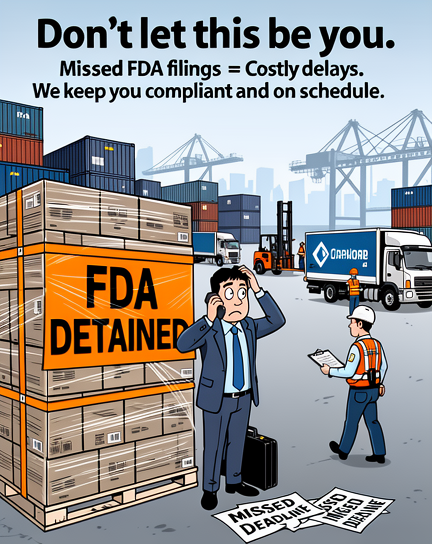
Handing an FDA Import Detention
FDA may detain an imported product if FDA finds that the product appears to violate the Federal Food, Drug and Cosmetic Act (FFDCA). When FDA detains the product, the Agency will issue a Notice of Detention and Hearing (detention notice) to the importer and to the importer’s Customs broker/filer, advising the importer how the product appears to violate the FFDCA. FDA provides the importer an opportunity for an administrative hearing (detention period) to overcome the appearance of a violation by providing testimony that challenges or overcomes the appearance(s) of a violation.
FDA may detain the product if it appears to be adulterated e.g. contaminated with Salmonella, illegal pesticide residue, unapproved color additive, etc. FDA may also detain the product for labeling (misbranding) violations. The FFDCA provides FDA the authority to detain an imported product merely on the appearance of a violation, giving FDA significant power in regulating the import industry. Due to this appearance standard, FDA can place a product on the “Red List” of an Import Alert and detain the red-listed product without having to test or otherwise physically examine it. FDA refers to this as “detention without physical exam” or “DWPE”.
During the detention period, the importer has the opportunity to overcome the detention by either providing FDA evidence demonstrating that the products comply with the FFDCA or by reconditioning the product as we will discuss in further detail below.
Evidence of Compliance
If FDA detains a product under an Import Alert, the importer may present evidence such as a private lab report demonstrating the product is free of the violation referenced in the Import Alert. For example, if the product is seafood detained under Import Alert 16-81 “Detention Without Physical Examination of Seafood Products Due to the Presence of Salmonella”, the Importer may submit a private lab report to FDA indicating the product is free of Salmonella. Or, if the importer believes FDA wrongfully detained the products, the detention period provides the importer the opportunity to contest the charges.
Reconditioning
Reconditioning a product involves treating or modifying the product to bring it into compliance with the FFDCA. For example, an importer may sterilize a product by heating, fumigation, irradiation, etc. to kill Salmonella. Or, the importer may relabel a product to correct labeling violations. Sometimes, FDA allows the importer to change the intended use of the product e.g. change the intended use of a product as a food to use as a non-FDA regulated product. To recondition the product, the importer must submit a written reconditioning proposal to FDA.
If FDA accepts the importer’s reconditioning proposal, FDA will usually examine or require testing of the products to verify that they were adequately reconditioned. For example, if the importer’s reconditioning proposal involves relabeling the products, FDA will usually have an investigator visually examine the shipment to make sure the products are all properly relabeled.
Responding to a Detention Notice
If the importer fails to respond to the detention notice before the end of the detention period or fails to successfully overcome the violation, FDA may refuse admission of the product into US commerce and issue a Notice of Refusal to the importer. Once FDA refuses the shipment, the importer must redeliver the goods to Customs custody usually within 90 days of the issuance of the Notice of Refusal, and the importer must either have the product exported or destroyed under FDA or Customs supervision. Read our article on FDA refusals for more information: FDA Refusals –What You Should Do If You Receive an FDA Notice of Refusal.
FDA’s contact information and the respond-by-date for responding to the detention notice are indicated on the notice. Note that the respond-by-date on the notice is not necessarily the deadline for submitting all the required testimony- it is the deadline to respond to the notice. So, for example, the importer should notify FDA before the respond-by-date if the importer plans to have a private lab test the detained product. However, the lab does not necessarily have to complete the testing before the respond-by-date. The importer should keep FDA apprised of the status of the lab testing and, if necessary, request an extension to the detention period.
Once FDA refuses a shipment, it becomes much more difficult to obtain a release for the shipment. That doesn’t mean that refusals are impossible to overcome, but you would need to provide very compelling evidence proving that FDA committed an error in refusing the shipment. So be sure to respond to the detention notice before the respond-by-date listed on the notice!
Other Tips:
- Telling FDA “I never received the detention notice from FDA and that’s why I didn’t respond in time” almost never works.
- Telling FDA “I’ve imported this same product for years, and it was never detained before” also almost never works.
- FDA rarely considers hardship as a basis for release e.g. “I’ll go out of business if this shipment is refused!”
- If a shipment is detained because FDA’s lab finds an adulterant, FDA rarely accepts private lab testing as testimony for overcoming the detention.
- Read the charges listed on the detention notice very carefully so you know what specific testimony is needed to overcome the detention.
- Always remember that FDA sometimes makes mistakes! FDA reviewers must review thousands of entries each year and are subject to human error like anyone else. That is why the detention period provides the importer the opportunity to challenge the detention if the importer feels the FDA detained the shipment in error.
We at FDA Specialist have had significant success in overcoming FDA detentions and refusals. We can advise you on whether FDA made a mistake in detaining or refusing your shipment and, if so, represent you before FDA to have the shipment released. Or we can inform you if any charges can be overcome via reconditioning and prepare and submit a reconditioning proposal to FDA on your behalf. So contact us right away if you receive a detention or refusal notice to see how we can assist you in getting the shipment released as quickly as possible!